(CEE directive 80/777/CEE)
"…can be defined mineral water only those waters with beneficial properties, linked to the presence of particular mineral salts and small amounts of oligominerals. Any restoring treatment of mineral waters is prohibited…" "…mineral water should be wholesome already at the source and should be bottled as it gushed from the source…"
| For the mineral content the waters are classifcate like: | |
DEFINITION |
RESIDUE FIXED |
| MINIMALLY MINERALIZED | da 0 a 50 mg/lt |
| OLIGOMINERAL | 50 a 500 mg/lt |
| MINERAL | 500 a 1500 mg/lt |
| IPERMINERAL | 1500 mg/lt |
To distinguish the type of water one buys, if it is not specified on the label, one needs only to check the values of the fixed residue which should be lower than 500mg/l for oligomineral waters and higher for mineral and hypermineral ones.

OLIGOMINERAL: |
|
MINERAL:
|

|
|||||||
S.Martino |
Ferrarelle |
S.Pellegrino |
Uliveto |
Lete |
Sangemini |
Boario |
|
| Residue Fixed | 2914,4 |
1290 |
1074 |
986 |
908,7 |
899,3 |
636 |
Calcium CA++ |
195 |
370 |
208 |
202 |
332 |
303,2 |
131 |
Sodium NA+ |
670 |
42 |
42 |
113,7 |
5,92 |
18,55 |
6 |
Sulfate SO4 |
288,07 |
4 |
534,6 |
151 |
5,96 |
52,42 |
246 |
Potassium K+ |
89,05 |
42 |
2,8 |
11,6 |
2,35 |
2,76 |
2 |
Idrocarbonico HCO3 |
2013,56 |
1372 |
222,7 |
683,2 |
1080 |
955 |
302 |
Magnesium M ++ |
69 |
22 |
53,5 |
29,8 |
15 |
15,5 |
40 |
Cloride CL |
294,24 |
22 |
68 |
121,4 |
9,5 |
17,7 |
4 |
Litium LI+ |
0,98 |
0 |
0,18 |
0,2 |
0 |
0,04 |
0 |
Fluorine F |
0,92 |
0,8 |
0,61 |
1,4 |
0,34 |
0,23 |
0,3 |
Nitric NO3 |
0,85 |
5 |
0,77 |
5,9 |
4,2 |
1,14 |
6 |
alkalinity PH |
7,29 |
6,2 |
7,5 |
6 |
6 |
6,8 |
6,92 |
Fe++ |
0,031 |
0 |
0 |
0 |
0 |
0 |
0 |
SAN MARTINO is the only IPERMINERAL water in Sardinia
Mineral waters contain good amounts of salts and the hypermineral ones are the richest. Unlike oligomineral waters, praised as very pure because they come down from very high mountains, the course which generates hypermineral and mineral waters is different.
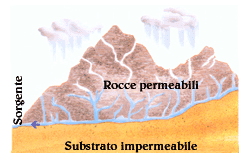 of these waters are usually
located in regions whose subsoil is volcanogenic: rainwater is absorbed by these
particular soils until it reaches the bottom of ancient extinct volcanos (about 6,000
below sea level). This slow route enriches it with the mineral salts present in the
ground. At this point the water settles for three or four years in the basin which once
contained lava, enriching it with natural carbon dioxide as well.
of these waters are usually
located in regions whose subsoil is volcanogenic: rainwater is absorbed by these
particular soils until it reaches the bottom of ancient extinct volcanos (about 6,000
below sea level). This slow route enriches it with the mineral salts present in the
ground. At this point the water settles for three or four years in the basin which once
contained lava, enriching it with natural carbon dioxide as well. Thanks to this, water finds the natural pressure to ascend the soil until it reaches
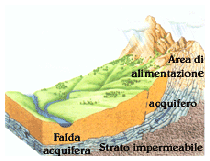 (after 5 or 6 years) the
sources. It is thanks to this process that mineral and hypermineral water gush out of the
source naturally sparkling. This gift of nature actually represents the fundamental
difference between the two typologies of water. It does not matter whether water contains
large amounts of mineral salts if these are not balanced.
(after 5 or 6 years) the
sources. It is thanks to this process that mineral and hypermineral water gush out of the
source naturally sparkling. This gift of nature actually represents the fundamental
difference between the two typologies of water. It does not matter whether water contains
large amounts of mineral salts if these are not balanced. All the components must be balanced so as to enhance the beneficial qualities or compensate for the rare negative effects of every single mineral. The balance of the mineral dissolved is one of the main characteristics of San Martino
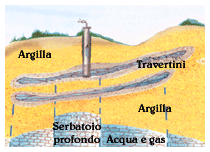 Mineral Water.
Mineral waters sold are rarely still and those that are have undergone a degassing process. In fact, they spring naturally sparkling and can be slightly charged with carbon dioxide. Although being fairly sparkling, they are not unpalatable, both for taste and amount of bubbles, simply because the molecule of CO2 is not quite alien to the water's real nature.